

Not because I’m obsessed with productivity—but because I kept having the same feeling:
I’m in the chair all day… yet the timeline barely moves.
If you’re an editor right now—especially in unscripted—you’ve probably felt it too. The work is choppier, schedules are tighter, budgets are meaner, and the expectations are weirdly higher.
So I ran a simple experiment: I categorized my day into two buckets:
- Real Editing: work that directly improves the cut (story, pacing, performance, clarity, emotion)
- Busywork: everything else (the stuff that has to happen but never gets credited or paid properly)
Here’s what I learned.
What Counts as “Real Editing”?
Real editing is the part we romanticize:
- building story arcs
- shaping character moments
- tightening pacing
- designing reveals
- making the cut feel inevitable
It’s the work that makes a producer say, “Oh wow… this plays.”
Real editing is also the hardest to do when your day is chopped into 12 tiny interruptions.
What Counts as Busywork?
Busywork isn’t “lazy” work—it’s unavoidable work that slowly eats your day:
- pulling selects because nobody logged anything
- endless exports with tiny notes
- re-wrapping specs / deliverables
- chasing missing assets and relinking media
- “Can we see a version without the music?”
- “Can you turn around a 6-minute and a 90-second and a social cut?”
- reviewing transcripts, fixing timecode issues
- syncing, organizing, labeling, duplicating sequences
- meetings that could’ve been a message
Busywork feels small. But it stacks.
And in a contracting industry, it stacks faster.
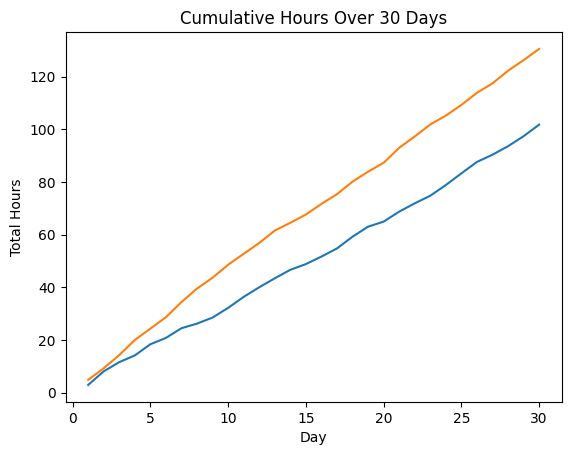
The 30-Day Reality Check
Here’s the uncomfortable truth the tracking made obvious:
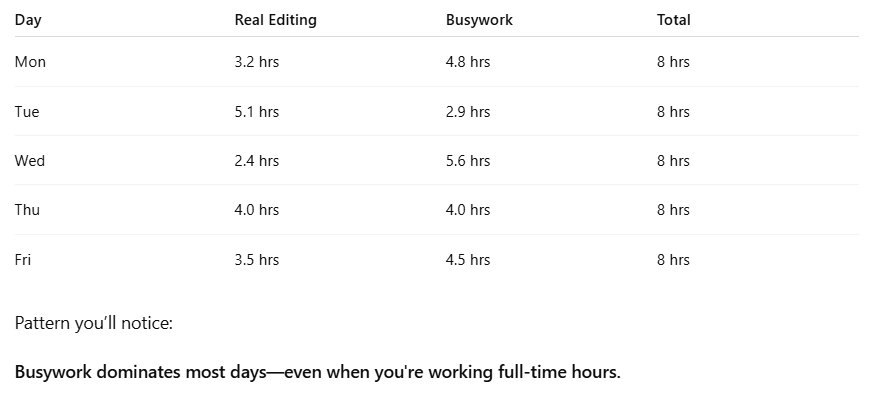
Most days, “real editing” was not the majority of the time.
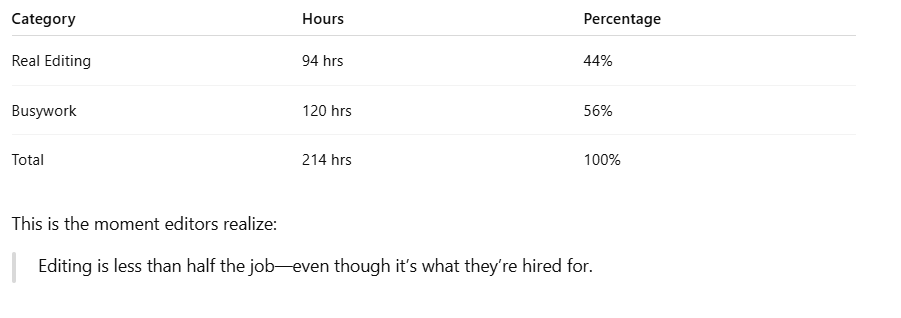
Even on strong weeks, real editing was constantly getting squeezed by:
- producers asking for more versions
- fewer assistants / smaller teams
- tighter post schedules
- more deliverables for the same rate
- less clarity upfront (“we’ll figure it out in post”)
That last one is a killer.
When an industry is booming, ambiguity is survivable.
When the industry is shrinking, ambiguity becomes expensive—and editors pay for it with their time.
Why Busywork Is Getting Worse (And Why It Feels Personal)
A lot of editors are asking:
“Do you think it’ll get better?”
Some of it may improve. But this part matters:
Even if production volume rebounds a bit, the structure has changed:
- fewer shows being produced means more competition
- more competition means lower leverage for editors
- lower leverage means “sure, add another deliverable”
- and that means more busywork disguised as “just a quick tweak”
In other words:
When budgets tighten, the unpaid parts of the job expand.
That’s why so many editors feel like they’re working harder for less.
The Biggest Surprise: Busywork Isn’t Random—It’s Predictable
Once you track it, patterns show up. Busywork tends to fall into a few repeatable categories:
1) Asset Chaos
Missing media, mismatched audio, messy handoffs, unclear versions.
2) Notes Inflation
Tiny changes, endless rounds, multiple stakeholders with conflicting direction.
3) Deliverables Creep
One cut becomes six. One format becomes three. One platform becomes ten.
4) Toolchain Friction
Relinking, conforming, exporting, uploading, converting, captioning.
5) Communication Tax
Meetings, Slack, email threads, “quick calls,” status updates.
None of those are “editing.”
But they can easily swallow your best hours.
What Editors Can Do About It (Without Becoming a Jerk)
You don’t need to be difficult. You need to be specific.
Here are moves that actually reduce busywork:
1) Name It in Your Process
Instead of “I edit,” your process becomes:
- ingest + organization
- story assembly
- fine cut
- finishing + delivery
Busywork shrinks when it’s visible.
2) Set “Notes Windows”
Example:
- notes due by 3pm
- changes delivered by 10am next day
- anything after becomes next round
This stops the drip-feed that kills flow.
3) Create a Deliverables Menu
Make “extra cuts” a line item:
- alt versions
- platform cutdowns
- captions / burned-in
- reformatting
- exports beyond X rounds
If you don’t price it, you train people to ask for it endlessly.
4) Protect Your Prime Edit Hours
Two protected blocks per day where you do not respond unless it’s urgent.
Your best work happens in uninterrupted stretches. That’s not a preference—it’s biology.
5) Make a Backup Plan Without Quitting Your Identity
A lot of editors are considering big pivots (accounting, trades, coding).
Fine. But don’t frame it as “giving up.”
Frame it as stabilizing your life while the industry re-sorts.
Because this isn’t about talent. It’s about volatility.
The Real Takeaway
Tracking my hours didn’t just show me where my time went.
It showed me why the industry feels worse than it looks on paper.
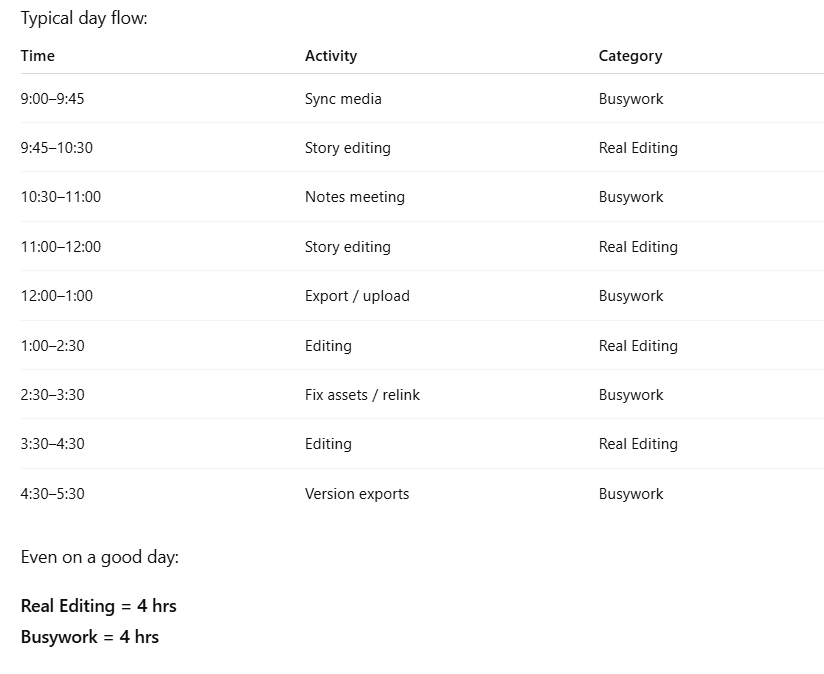
Even when you’re booked, you can feel broke and burnt out if:
- half your time is unpaid labor
- your flow state is constantly interrupted
- you’re delivering more for the same rate
- you’re carrying the cost of chaos
And that’s the part nobody tells you before you go full-time.
The job isn’t just editing.
It’s managing a system where editing is only one piece.
Are you tired of the endless and frustrating job search process? Look no further than FasterGig – the smarter, automated method that will help you get remote video jobs 10 times faster with minimum effort.
With FasterGig, you can find new job opportunities in your area or even remote positions without the need for previous experience. Our website offers a quick and easy way to apply to jobs and find gigs that fit your skills and needs.
Say goodbye to the stress and time-consuming job search process and hello to a new job with FasterGig!
Click here to get started on your journey towards a brighter and more fulfilling career in the video production industry.